Padel vs Pickleball
Two of the fastest-growing racquet sports in the world. Here's how they compare.
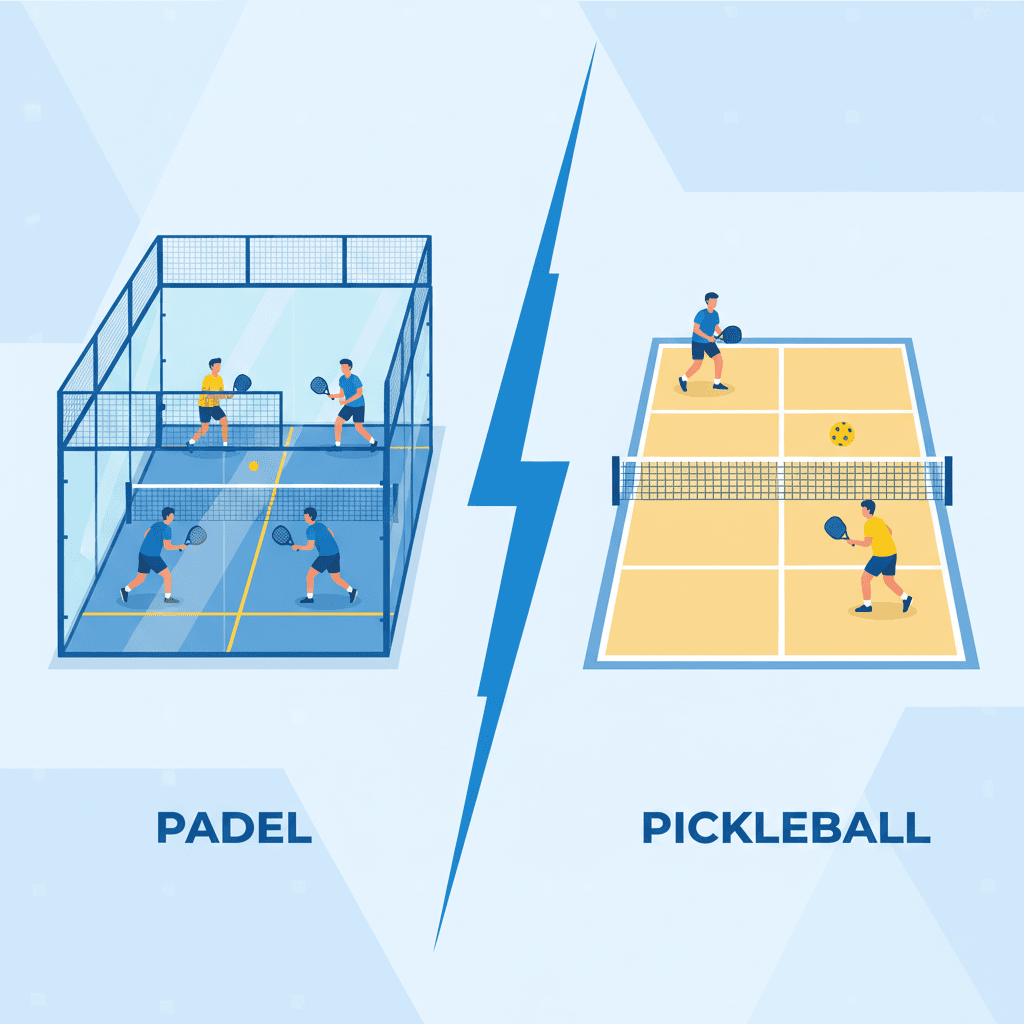
At a Glance
| Feature | Padel | Pickleball |
|---|---|---|
| Court Size | 20m x 10m (enclosed with glass walls) | 13.4m x 6.1m (open court) |
| Equipment | Solid paddle (no strings), depressurized tennis ball | Solid paddle, plastic wiffle ball |
| Serving | Underhand, below waist level | Underhand, below waist level |
| Walls | Yes - ball can be played off walls (like squash) | No walls |
| Scoring | Same as tennis (15, 30, 40, game) | Rally scoring to 11 (win by 2) |
| Players | Doubles only (2 vs 2) | Singles or doubles |
| Origin | Mexico, 1969 | Washington State, USA, 1965 |
| Popularity | 25M+ players globally, #1 in Spain | 5M+ players in US, fastest-growing US sport |
Detailed Comparison
Court & Playing Environment
Padel
Padel is played on an enclosed court roughly 1/3 the size of a tennis court. The court is surrounded by glass walls and metal mesh fencing, making it a unique hybrid of tennis and squash. The walls are in play, adding strategic depth as players can use them to return shots.
Pickleball
Pickleball uses an open court similar to a badminton court. It's smaller than a tennis court and features a 7-foot "no-volley zone" (the kitchen) near the net. The smaller court makes it accessible and less physically demanding.
Equipment
Padel
Padel rackets are solid (no strings) with a perforated surface, typically made of carbon fiber or fiberglass. They're about 45cm long with a wrist strap. The ball is similar to a tennis ball but with slightly less pressure, making rallies longer and more engaging.
Pickleball
Pickleball paddles are also solid but larger and rectangular, made from wood, composite, or graphite. The distinctive plastic wiffle ball has holes that reduce speed and bounce, making the game more about placement than power.
Gameplay & Strategy
Padel
The walls add a unique tactical dimension. Players must read the ball off the glass, create angles, and use "bandeja" and "vibora" shots. The game rewards patience, positioning, and smart play over raw power. Doubles-only format emphasizes teamwork and court coverage.
Pickleball
The "kitchen" no-volley zone creates a unique dynamic where players can't smash at the net. Strategy focuses on "dinking" (soft shots into the kitchen) and creating opportunities for put-away volleys. Quick reflexes and soft hands are valued.
Learning Curve & Accessibility
Padel
Easy to start, difficult to master. The enclosed court keeps the ball in play longer, making rallies accessible for beginners. However, mastering wall play and advanced techniques takes time. Great for tennis players transitioning to a new sport.
Pickleball
Very beginner-friendly with a gentle learning curve. The slower ball and smaller court make it accessible for all ages and fitness levels. Popular among retirees and families, though competitive play has significant depth.
Physical Demands
Padel
Moderate to high intensity. Requires good lateral movement and the ability to react quickly to wall bounces. Longer rallies provide excellent cardio. Less running than tennis due to smaller court, but more than pickleball.
Pickleball
Low to moderate intensity. The smaller court means less running, making it easier on joints. Ideal for players seeking a social, active sport without intense physical demands. Can still be competitive and fast-paced at higher levels.
Which Sport Is Right for You?
Choose Padel If You...
- Love tennis or squash and want something new
- Enjoy strategic, tactical gameplay
- Want a doubles-focused social sport
- Are looking for a good cardio workout
- Find the wall-play concept intriguing
Choose Pickleball If You...
- Want to play singles or doubles
- Prefer a gentler, lower-impact sport
- Want easy access to courts (many public options)
- Are joining a community with many age groups
- Value quick games (typically 15-20 minutes)
Ready to Try Padel?
Discover 273+ padel courts across the United States and United Kingdom. Find a court near you and experience this exciting sport.
Frequently Asked Questions
Is padel harder than pickleball?
Both sports are easy to learn, but padel has a higher skill ceiling due to the wall play. Pickleball is generally considered more beginner-friendly, while padel offers more tactical complexity as you advance.
Can I use a pickleball paddle for padel?
No, the equipment is different. Padel rackets are larger, heavier, and designed for a pressurized ball. Pickleball paddles are lighter and made for a plastic wiffle ball. Each sport requires its specific equipment.
Is padel the same as paddle tennis?
No. Paddle tennis (now called POP Tennis in the US) is a different sport. Padel is played on an enclosed court with glass walls, while paddle tennis is played on an open court. They use different balls and have different rules.
Which sport is more popular?
Pickleball is currently more popular in the US with over 5 million players. Padel dominates in Europe and Latin America with 25+ million players globally. Both are growing rapidly in the US market.
How is padel different from tennis?
Padel uses a smaller enclosed court with glass walls that are in play, solid rackets without strings, and underhand serves only. The scoring is the same as tennis, but the game is always played as doubles with walls adding a strategic dimension similar to squash.